I was interviewed by CBC Vancouver radio and CBC Kelowna radio on the very sad passing of Brian Wilson, and about his musical legacy, You can listen to the interviews here and here.
music
Jill
This past Thursday was the first full day off I’d had for a couple of weeks. I was sitting in a coffee shop, drinking a latte and doing a word puzzle, and decided to look at my email on my phone. Just as I opened my email account, a message came in, with a subject line so shocking I thought at first I had misread it. “Jill died in a house fire.”
“Jill” is Jill Sobule, who I took songwriting classes with during the pandemic. The email was from a friend in my online songwriting group – a group that grew out of Jill’s classes. The heartfelt tributes from Jill’s friends and colleagues describe what I saw in those classes. She was generous, kind, incredibly talented, and funny. I’m so grateful that I got to learn from her.
In the 1990s, I knew Jill from her hit singles: “I Kissed A Girl” from her second album, and “Supermodel” from the soundtrack of the movie Clueless. (“Two-hit wonder”, she always pointed out whenever someone called her a “one-hit wonder”.) I started following her on Twitter around 2018 or so, because her Tweets were hilarious. Then in April 2021, when we were all stuck at home during the pandemic, Jill announced on Twitter that she would be doing a series of online songwriting classes. I thought about it, and got up the courage to DM her. I asked whether absolute beginners could participate, and she replied, “Sure!”
I’ve taken music lessons and can read music, but other than singing in choirs at school I’ve never been a performing musician. And as much as I like music, I had never felt the impulse to write songs. Obviously I like to write prose, and I can make up little melodies to entertain myself, but I had no idea how anyone went about connecting those two things. I had concluded that other people had the songwriting gene, but I did not.
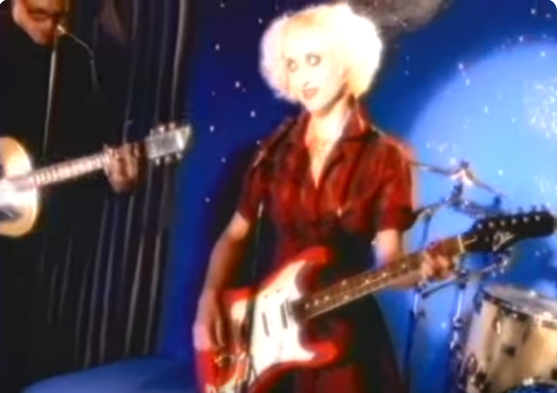
Jill in the video for “Supermodel”. (photo credit: YouTube)
But when I saw Jill’s offer, I thought, well, she writes great songs, and if I write about music I should probably learn something about how songwriting works. So, with some degree of apprehension, I signed up for the four class sessions.
At the start of the very first class, Continue reading
“Mixtape” Review
Issue #62 (summer 2023) of Ugly Things magazine includes a very positive review of my book Mixtape. Thanks to editor Mike Stax for supporting independent authors & publishers! 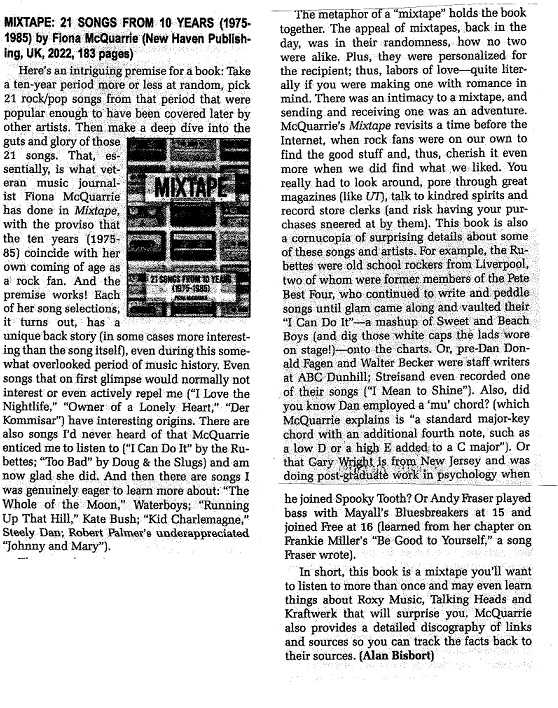
MIXTAPE Now Available
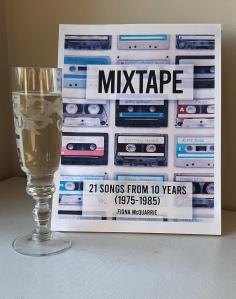
My new book MIXTAPE: 21 SONGS FROM 10 YEARS (1975-1985) is now on sale. You can buy it at any of the retailers listed here. It was a lot of fun to write, and I hope you have fun reading it!
“Her Country”: An Interview with Author Marissa Moss
Women have always been an integral part of country music, starting with pioneers such as the Carter Family and Patsy Montana. Yet country music has also marginalized women musicians – even more so in the last decade. In 2015, a country radio consultant publicly stated that songs by women were “not the lettuce in our salad…[they are] the tomatoes“. In 2019, women artists represented only 10 percent of the music played on US country radio stations that year.
Music journalist Marissa Moss, who’s based in Nashville, saw women in country music making great music at the same time that the industry was focusing on “bro country“, and saw women trying to be successful their own way in an industry that wanted them to conform to very narrow stereotypes. Her new book Her Country: How the Women of Country Music Became the Success They Were Never Supposed to Be tells the stories of three female country musicians – Maren Morris, Mickey Guyton, and Kasey Musgraves. Through unpacking their experiences, it touches on racism, sexism, corporatization, politics, and oppression, and how all of those shape performers’ careers and the music we listen to. The book is ultimately hopeful, but it also pulls no punches in describing how badly the country music industry can treat women.
I found Her Country to be an extremely thought-provoking and rewarding read, so I was delighted to have the opportunity to interview Marissa about it.
Fiona McQuarrie (FM): What motivated you to write the book?
Marissa Moss (MM): I had been covering this beat in Nashville, at the time I started writing the book, for about eight years, and it just felt Continue reading
Lost One Rainy Morn: Ian & Sylvia’s “The French Girl”
[originally appeared in Shindig! issue 111]
‘The French Girl’ is the musical equivalent of an Impressionist painting: sparse lyrical images weaving together to create an intricately detailed world. Three silver rings, a dark-haired woman, a cozy room, glasses of red wine…..and then she disappears, and no one knows who she was or where she has gone. It’s romantic, but with an underlying and somewhat unsettling sense of unreality.
Ian and Sylvia Tyson wrote the song in late 1965, during what Sylvia described to their biographer John Einarson as “a very transitional period for us”. As the duo of Ian & Sylvia, they were stars on the folk rock circuit, and had already released four albums on the Vanguard label. Songs like Ian’s ‘Four Strong Winds’ and Sylvia’s ‘You Were On My Mind’ had brought them acclaim as songwriters. But they were well aware that Continue reading
Dave Morrell’s ‘Run-Out Groove’
I interviewed longtime Capitol Records promotion man Dave Morrell for PopMatters. Dave has just released the book Run-Out Groove, the fourth volume of his memoirs of the music industry. You can read the interview here.
Podcast Interview with All Music Books’ “Deep Dive”
I was interviewed about my book Song Book for the All Music Books website’s “Deep Dive” podcast. Steve J and I had a great chat about the book and some of the stories in it. The interview is posted here.
Second Fiddle to No Man: Beverley Martyn and Linda Thompson
I wrote an article for the Please Kill Me website on Beverley Martyn and Linda Thompson: two musicians who should be recognized for much more than their collaborations with their ex-husbands. You can read the article here.
“Ted Templeman: A Platinum Producer’s Life In Music”
Producer Ted Templeman, who has worked with dozens of artists – including Captain Beefheart, Van Morrison, the Doobie Brothers, and Van Halen – has finally written an autobiography. As you might guess, it’s wide-ranging and very interesting. I reviewed it for PopMatters; you can read the review here.
 Writing on Music