This past Thursday was the first full day off I’d had for a couple of weeks. I was sitting in a coffee shop, drinking a latte and doing a word puzzle, and decided to look at my email on my phone. Just as I opened my email account, a message came in, with a subject line so shocking I thought at first I had misread it. “Jill died in a house fire.”
“Jill” is Jill Sobule, who I took songwriting classes with during the pandemic. The email was from a friend in my online songwriting group – a group that grew out of Jill’s classes. The heartfelt tributes from Jill’s friends and colleagues describe what I saw in those classes. She was generous, kind, incredibly talented, and funny. I’m so grateful that I got to learn from her.
In the 1990s, I knew Jill from her hit singles: “I Kissed A Girl” from her second album, and “Supermodel” from the soundtrack of the movie Clueless. (“Two-hit wonder”, she always pointed out whenever someone called her a “one-hit wonder”.) I started following her on Twitter around 2018 or so, because her Tweets were hilarious. Then in April 2021, when we were all stuck at home during the pandemic, Jill announced on Twitter that she would be doing a series of online songwriting classes. I thought about it, and got up the courage to DM her. I asked whether absolute beginners could participate, and she replied, “Sure!”
I’ve taken music lessons and can read music, but other than singing in choirs at school I’ve never been a performing musician. And as much as I like music, I had never felt the impulse to write songs. Obviously I like to write prose, and I can make up little melodies to entertain myself, but I had no idea how anyone went about connecting those two things. I had concluded that other people had the songwriting gene, but I did not.
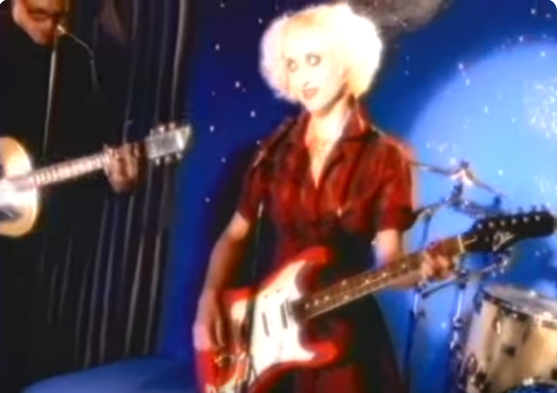
Jill in the video for “Supermodel”. (photo credit: YouTube)
But when I saw Jill’s offer, I thought, well, she writes great songs, and if I write about music I should probably learn something about how songwriting works. So, with some degree of apprehension, I signed up for the four class sessions.
At the start of the very first class, with all 10 of us on the Zoom screen, Jill welcomed everyone and asked each of us to introduce ourselves. With each introduction, I felt more and more out of my league. There were people who were or had been professional musicians. There were people who had released their own albums. There were people who had released albums on labels that I knew. And of course, Jill herself had had two hit singles, released several albums, done lots of tours and concerts, and collaborated with lots of other artists. Then there was me.
To be honest, I was slightly overwhelmed. From my own experience in teaching, I know how difficult it is to have a group of students with a very wide range of abilities – to make them all feel included and to teach each one something helpful at their level. But Jill seemed pretty relaxed about it all, so I thought, “She must know what she’s doing. Let’s see what happens.”
The first exercise Jill got us to do was the “20-minute song”. She set a timer for 20 minutes, and told us to write a song about the first thing we would do when the pandemic was over. At the end of the 20 minutes we would perform our song for the rest of the class. She said it didn’t matter if the song wasn’t finished, it didn’t matter if we couldn’t accompany ourselves on an instrument – whatever we had to share was absolutely fine. She also mentioned that a friend was going to drop into the class, and might be there in time to listen to our songs.
Wow. Okay. I thought about my friends in the UK and how much fun it was to visit them, and constructed a couple of verses about getting on a plane, walking down a street in London, and meeting everyone at the pub. As I wrote out the words, I heard a rhythm in how they were fitting together, and a hint of a melody started to run through my head. Then the timer went off.
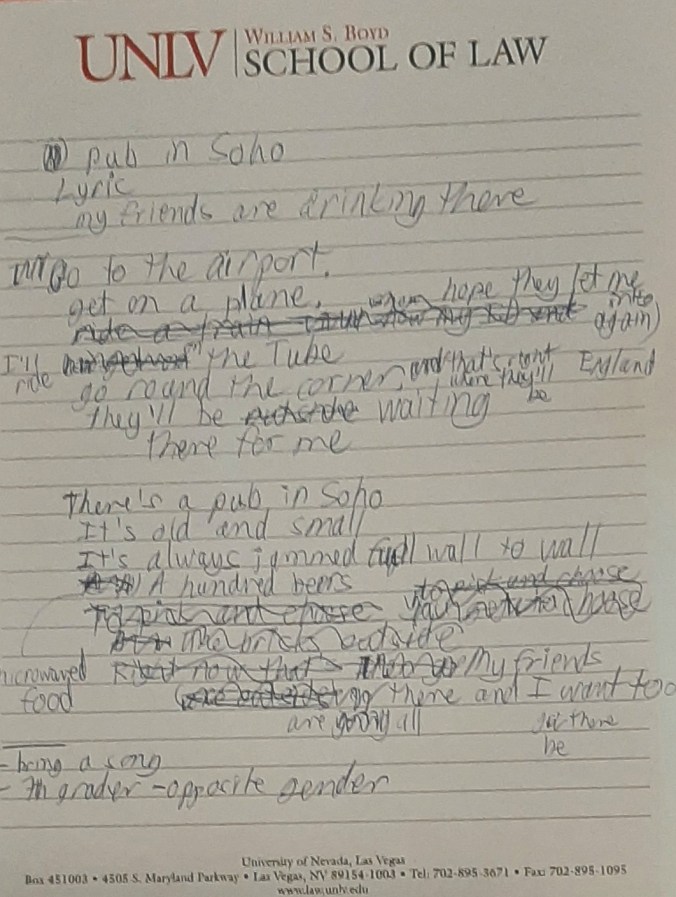
The rough notes for my “20-minute song”.
We all turned our cameras back on, and I saw that a new face had joined the Zoom screen. Jill said, “Hey, everyone, this is Larry Klein.” *That* Larry Klein? The bass player who was Joni Mitchell’s producer? I discreetly Googled him and discovered that, yes, it was him, and he also had won four Grammy awards and worked with dozens of other famous musicians. But just like Jill, he seemed very friendly and unpretentious, and glad to be hanging out with us.
And then Jill said, “Fiona! Why don’t you start?” I thought I was going to pass out. I was already thoroughly terrified at the idea of performing in front of this extremely accomplished group, but….now I was going to perform the very first song I had ever written?!? In front of LARRY KLEIN?!? I felt like I was standing on the very top diving board at the pool, staring at the water far, far below. A brief thought flashed through my head that I could just say, no, I don’t feel like it, but that was quickly followed with, just do it and get it over with.
So I held onto my piece of paper and read my little composition, not exactly singing it but kind of giving the words a beat and a bit of performance. When I finished, I braced myself – and Larry smiled very genuinely and said, “That was really nice.” I thought I was going to pass out again. At the end of the class, we all thanked Larry and Jill profusely. I turned off my Zoom camera and sat there in shock. What had just happened?
And that was the start of a great adventure, through the rest of the four classes, and through the other two sets of classes that I took with Jill. (This is a song that I wrote during the second set of classes.) She gave us homework every week, and that reinforced to us that songwriting is something you learn by doing it a lot, and the more you do it, the more you learn about how to do it.
Jill also helped us understand that a lot of the songs any songwriter writes are going to be bad songs – and that’s okay. When we played our songs in class, no matter how unfinished or tentative they were, Jill gave us feedback that was always insightful while also being supportive. She would call on each of us in turn to play our song for the week, and when she called on me, she always called me “Miss Fiona”. I don’t know why she did that, but it always made me smile.
Jill told us stories about her own experiences. I now realize that she was telling us those stories not just because they were entertaining, but also because she wanted the stories to help us. For example, it was pretty obvious that I was not comfortable singing solo. So one week Jill told us that the first time she sang by herself in public was in college, during a semester abroad in Europe. Her friends dared her to go busking on a street in Spain, and she said, “I decided, I can do this in front of these people [the Spaniards on the street] because I’ll never see any of them ever again.” We all laughed, but it struck me that somehow Jill got from there to being a really confident and engaging performer. That made me feel a lot better about singing my songs on my own.
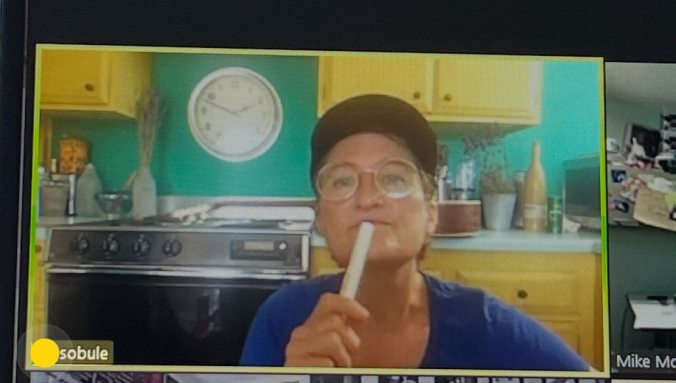
Jill during one of our online classes. (photo credit: Sam Wilson/Facebook)
Jill’s inclusivity and generosity were also apparent from the guests that joined our classes. The music business can be extremely nasty and political, and Jill herself was certainly victimized by it at different times. But the musicians she brought into our classes, no matter how accomplished or well-known they were, were unfailingly professional and gracious. Not a single one of them had the least bit of attitude, or acted like we should feel lucky to be in their presence. They seemed genuinely glad to be there, and they enjoyed themselves. (I missed the week when Lloyd Cole dropped in, but everyone told me the following week how impressed they were that he did that week’s in-class songwriting exercise along with them, and played his song in turn, just like everyone else in the class.)
To be honest, some of what I also learned from Jill was patience. During the second and third sets of classes, she was working on several other projects – she was performing in a musical and writing a musical and travelling around. Sometimes she got the time zones mixed up, and we showed up for class but she didn’t. And then she would have to reschedule, which didn’t always work out. But she was always cheerful no matter how tired or busy she was – we always felt she was thrilled to see us, even when she was participating on her iPhone from someone else’s apartment at the end of a long day.
Sometimes at the end of a class, Jill would perform a song of her own. The one that really stuck with me was “Jetpack”. She told us she wrote it while she was living in one part of New York City and the person she was dating was living in another part of the city. She dreamed about having a jetpack so she could fly over to see that person whenever she could.
I love the sense of freedom and whimsy in that song. Wherever Jill is now, I hope she got that jetpack. I hope she flies as high and as far as she wants, whenever she wants. And I hope she knows how much she was and is loved.

